How adapted yoga is helping people with Parkinson’s stay active, independent and connected
SHARE


When British Wheel of Yoga (BWY) teacher Susan Prosser qualified 25 years ago, she taught what she describes as ‘normal yoga classes’. Over time, more and more people began approaching her to say they couldn’t manage a traditional class but still wanted to experience the benefits of yoga. Trying to integrate them into existing groups didn’t work, so Susan began to specialise – first adapting a class for people with MS, then, as her own father developed Parkinson’s, exploring how yoga could support people with neurological conditions more widely.
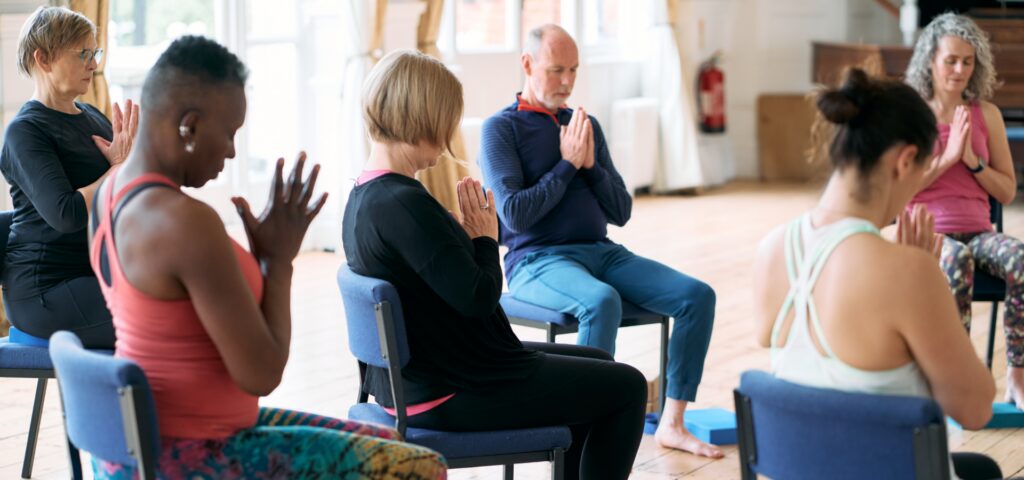
Around two and a half years ago, the local Parkinson’s UK group in Solihull approached Susan to ask if she would teach a dedicated yoga class as part of their programme. Now, every Thursday morning at a retirement village in Shirley, she leads a 60-minute class for up to 12 people with Parkinson’s. Funded partly by Parkinson’s UK, the class runs alongside the group’s regular coffee morning.
The sessions are predominantly chair-based, with around three-quarters of the practice done seated. Props – Pilates balls, resistance bands, yoga blocks and small massage balls – play a big part in making movement both effective and accessible, and students are encouraged to wear everyday clothes. Familiar postures are broken into smaller, manageable steps, with clear explanations of the benefits so participants understand why they’re doing what they’re doing.
Susan draws on specialist training in yoga therapy and yoga for people with life-changing illness, combined with nearly 20 years of experience adapting postures. The group is mixed: men and women, people at different stages of Parkinson’s, and even one participant living with both MS and visual impairment.
“Yoga is one of the most beneficial complementary therapies for Parkinson’s,” Susan explains. “It helps increase flexibility, improve posture, loosen tight and painful muscles and rebuild confidence.”
The results can be striking. “One man who couldn’t walk into the class at first was able to stride out by the end of the session,” she says. “This group tends to be especially committed, and they often tell me they feel a real boost in their wellbeing and self-worth, because they know they’re actively investing in their own health.”
Breathwork and relaxation are woven throughout every class, with techniques such as ujjayi, lion’s breath and humming bee breath used to support mood, anxiety and sleep. Several students have told Susan they use the breathing exercises during medical appointments and scans. “It helps calm them, especially if the news isn’t what they were hoping for,” she says. “And they tell me the postures make a real difference to everyday independence — from getting in and out of bed to managing hospital appointments.”
Beyond the physical and mental benefits, community matters too. The class has its own WhatsApp group, providing peer support between sessions. Susan is a clear about the wider need: “Standard classes can be inaccessible or even risky for people with Parkinson’s. This space gives them something that is truly theirs — somewhere they can move, breathe and be themselves without fear or embarrassment.”
Her advice to anyone considering adapted yoga is simple: find a teacher who can tailor a class to your needs and give it a try. “It can change your life,” she says, “and support growth in more ways than you might imagine.”
Susan Prosser is a BWY Teacher. For more information about her adapted yoga classes visit: https://localsupport.parkinsons.org.uk/activity/yoga-parkinsons-solihull
To celebrate World Parkinson’s Day, the BWY is hosting a free 45-minute online Chair Yoga session on Friday 10 April, 12.15–1pm. The class is open to anyone living with Parkinson’s, those supporting a friend or family member, or yoga teachers interested in inclusive techniques. The session will also be recorded for those who can’t attend live.
For all media inquiries
Natalie Lyndon, BWY PR & Communications Officer