Spring Cleaning from the Inside Out
SHARE


By Donna Negus, BWY Course Tutor and Regional Volunteer
Spring invites us to throw open the windows, let in fresh air and clear out what we no longer need. We dust neglected corners, sort through cupboards and decide what stays and what goes. On the surface, it all sounds simple. Yet as soon as we carry a bag of belongings to the hallway, doubt creeps in and things drift back into the cupboard.
Letting go of possessions may look practical, but it often touches deep emotions. When we release what we no longer need around us, we also begin to create space within ourselves.
We often notice what we’re holding only when the body feels tense or heavy. Last year I had to clear my childhood home – fifty years of memories and family history. It was an exhausting, emotional process. The smallest discovery could awaken powerful memories. Unprocessed emotions settle in the body as tension or discomfort: the pain in our neck, the knot in our stomach, the lump in our throat. Giving away belongings is easier than releasing the feelings that accompany them.
The first step in letting go is simply to notice.
Practice and letting go
Yoga teaches that practice (abhyasa) and letting go (vairagya) go hand in hand. When we rest awareness on the present moment, we loosen our grip on thoughts, outcomes and identity. Detachment does not mean indifference: it is the clarity that allows us to act without clinging.
Letting go of tension is rarely a one‑off act. We might think we’ve moved past something, only for an event or conversation to stir it again. Like ivy creeping back over a fence, old habits and memories can reappear. The practice is to notice rather than judge, and begin again with patience.
On the mat, this means arriving without expectation. So often our minds are crowded with what we think we should be. These thoughts distance us from the reality of how we are right now. It takes courage to practise honestly, to listen rather than push, and to let the body reveal what it knows. The same gentle courage helps us face pain, change and uncertainty beyond the mat.
Turning towards the dusty corners
We are often so busy supporting others that we forget to listen to our own bodies. Tension is rarely random; it’s an accumulation of experience. Every joy, loss and responsibility leaves its imprint. The aim is not to erase our history but to meet it with kindness.
Letting go begins by stopping, by turning inward and listening carefully. The mind likes control and has plenty of opinions about what we ought to feel, yet we can soften this inner voice. We might invite the feet to sense the ground, allow the shoulders to release their load, or notice which muscles quietly compensate when another lets go. Through this friendly attention, we begin to trust the body again.
Practising in this way creates internal space. The shift is subtle but it allows breath and movement to flow more freely. Just as a spare room can become a dumping ground for ‘stuff’, our tissues can store fear or unresolved emotions.
When we start to declutter the body, lightness follows. A cleared shelf or loft looks instantly more spacious; similarly, when we release what we no longer need, we stand taller and breathe more easily.
Simple practices for spring
Beginning is simple: feel the ground. The earth is steady and supportive, reminding us we don’t have to hold ourselves alone. You can explore this in standing, sitting or lying – the posture matters less than your attention.
Try a few quiet moments of connection:
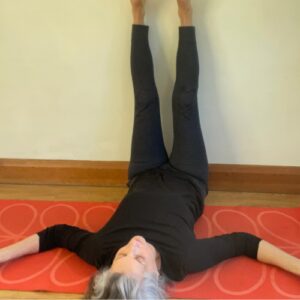
Give your weight to the ground: Lie on your back with your lower legs supported on a chair or with your legs up a wall. Take time to feel the back of your body against the floor. Sense how the weight of the legs travels through the thighs into the hip joints and pelvis. Allow the hip sockets to melt towards the floor. Give up any effort to ‘hold on’ to the legs and let the earth do the work.
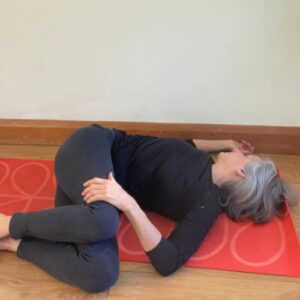
Try a supine twist: Still lying on your back, let both knees fall to one side while your shoulders stay anchored. If your knees fall to the right, feel how the right ribs, waist and hip make contact with the ground. Imagine everything around the left hip – ligaments, muscle, fascia and fluid – softening and pouring towards the right hip, as if you were emptying a jar into a bowl. With patient awareness, sense a slow upward movement from the lower hip to the upper hip. Repeat this inner action a few times until the upper hip feels further away and the lower hip feels lighter and more spacious.
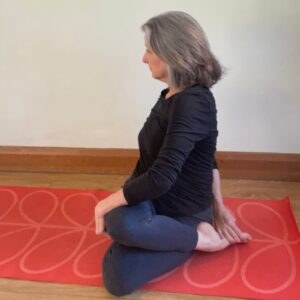 Comfortable seated twist: Sit on a chair or cushion and sense the support under your sitting bones or feet. Begin a small rotation from the base of the spine and let it ripple upwards, like a wave moving through tall grass. Keep your attention on the inner experience rather than how the pose looks. Noticing what happens inside like this can awaken a powerful, kindly curiosity.
We often associate Spring with cleaning and decluttering the home, but we can also release unneeded tension every time we step onto the mat. Over time, we realise it is not really the objects we struggle to let go of; it is the emotions and stories we have woven around them. Yoga gives us tools to notice those stories, to breathe with them and, little by little, to put them down.
Donna is a long-term student of Vanda Scaravelli’s approach and teaches subtle, spine-led yoga that encourages movement without force. She weaves mindfulness and compassion through all her classes. Her next teacher training course starts on 5 December 2026 (Introductory Day: 26 September 2026).
For all media inquiries
Natalie Lyndon, BWY PR & Communications Officer