82-year-old yoga teacher living with Parkinson’s shares his practice to help others
SHARE


An 82-year-old yoga teacher is using his own daily practice to help others with Parkinson’s feel the benefits of movement.
Tony Bunzl, a retired antiques dealer and longtime British Wheel of Yoga (BWY) teacher, was diagnosed with Parkinson’s disease eight years ago at the age of 74. Despite progressing symptoms that have led him to step back from teaching classes, Tony still unrolls his yoga mat every morning, and is now recording videos to support others living with the condition.
A diagnosis which changed everything
Tony’s journey to diagnosis began with a worsening tremor that his GP repeatedly dismissed. It was his wife who pushed for a private brain scan which confirmed Parkinson’s.
At the time, Tony was teaching five yoga classes a week, running yoga holidays from the couple’s home in Italy and leading retreats in France. A consultant told him early on that successful management would be “fifty per cent medication, fifty per cent exercise.” He took it seriously.
Today, Tony threads his prescribed drugs through an elaborate daily ritual: yoga asana, PD Warrior drills, neurophysio exercises and Tibetan healing practices. It is, he says, what keeps him going.
A lifetime on the mat
Yoga has run through Tony’s life for more than 40 years. He came to it not for fitness, but to manage depression. Maggie suggested he join her at a class at Mayfield School in Wandsworth. He had never been sporty as a boy, but something clicked.
“A good stretch made me feel more positive,” he recalls.
At 54, he was invited to train as a yoga teacher by local British Wheel of Yoga representative Val Field. Inspired by the Satyananda tradition, for two decades he ran predominantly male hatha yoga classes across Wandsworth — at gyms, a university college and from home. He stopped teaching two years ago, as the Parkinson’s progressed. He never stopped practising.
Relearning his own body
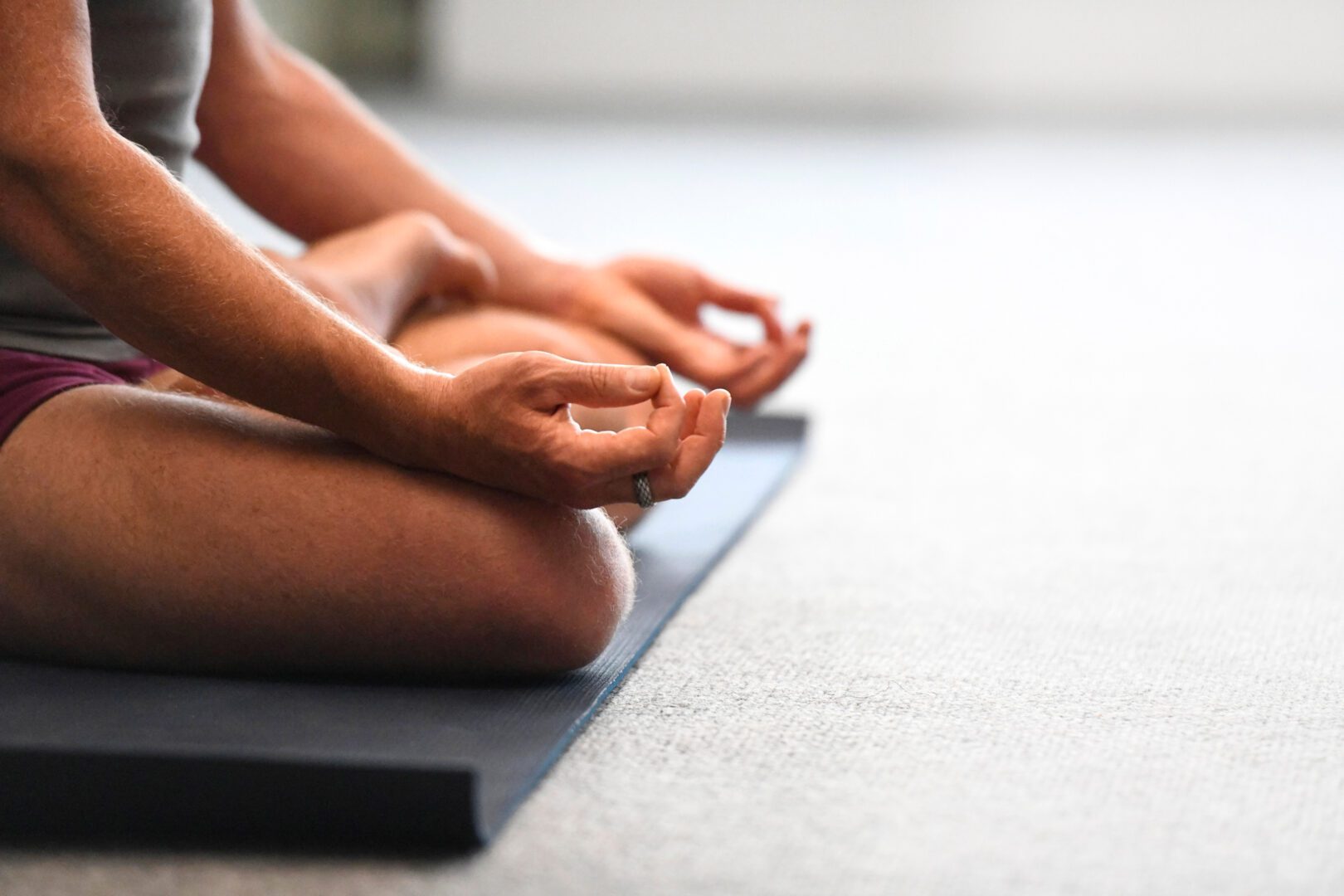
Diagnosis changed the way Tony worked with his body. His morning now begins with Vipassana — a Buddhist body-scan meditation — before moving into asana. He rotates his sequences across three days: one day standing work, one day lying on his back, one day on his front. The structure helps him remember the order of postures and ensures every part of his body is addressed.
“Asana helps alleviate some of the symptoms. It makes me feel better. It has become a morning ritual,” he says.
Alongside classical yoga postures, Tony threads in the PD Warrior exercises he learned at his local Parkinson’s centre, including balance drills, big “opening” steps, resistance‑band work, brisk squats and boxing‑style turns. These explicitly target the slowness, stiffness and small movements that characterise Parkinsonian gait.
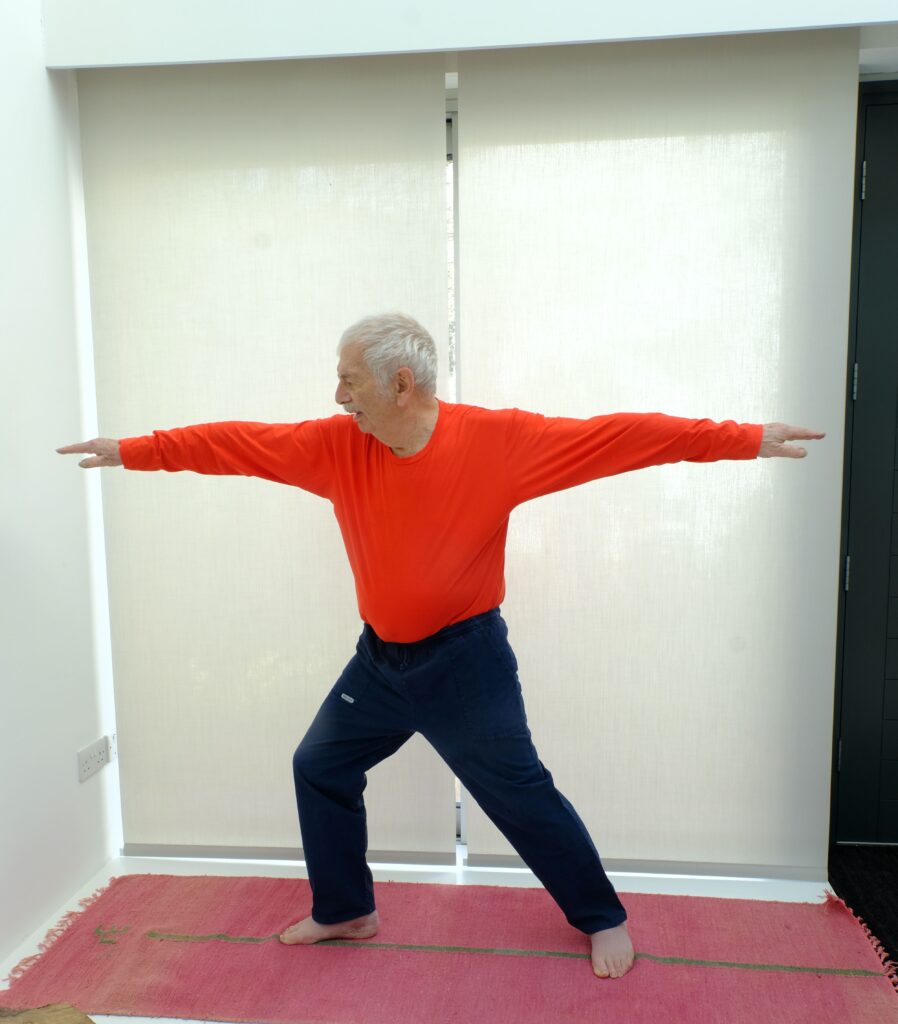
“Yoga works on many different levels – confidence, strength, balance and positivity,” Tony says. “The Warrior postures have become especially important for my leg strength and sense of agency. My balance isn’t what it was, but I can still stand on one leg.”
More recently, Tony has added Kum Nye yoga, a Tibetan healing practice in which small, slow, deliberate movements are designed to awaken subtle sensations. For Tony, it offers another way to work with a nervous system that no longer does his bidding quite so readily.
New videos to support others with Parkinson’s
Tony has no illusions. His Parkinson’s has progressed; he walks more slowly, falls more easily, and has let go of his yoga classes. But every morning the mat goes down. It does not fix everything. It does not need to.
“It makes me feel better,” he says. For now, that is enough.
Tony is now recording a series of short videos to help other people with Parkinson’s feel the benefits of yoga for themselves. The videos will break down what is helping him in his own practice.
“I want to share what works for me,” Tony says. “If it helps even one person feel a bit stronger or more positive, it will be worth it.”
For all media enquiries
Natalie Lyndon, BWY PR & Communications Officer