Supporting People Living with Parkinson’s
SHARE


BWY tutor Michelle Griffiths introduces her new specialist short course, launching in November, for yoga teachers who want to support people living with Parkinson’s
Michelle Griffiths’ relationship with yoga began at the age of five, as part of her own rehabilitation for Ehlers-Danlos syndromes (EDS). From an early age, she learned how meditation, pranayama, mudra and mantra could help her manage pain and understand her condition, with asana and Pilates following a few years later.
Supported by forward-thinking parents and an exceptional physiotherapist, Michelle was encouraged to see movement not as performance, but as a way of listening, adapting and living more fully. At 18, she began volunteering in rehabilitation hospitals, working with young adults and later supporting her mum’s rehabilitation after a haemorrhagic stroke. That experience lit a lifelong curiosity: how can movement, breath and self-awareness support function, independence and confidence?
Twenty-three years into teaching, neuro-rehabilitation through yoga and Pilates has become one of the central threads of Michelle’s work, connecting her with the NHS, charities and the wider community. It has also taught her that the best teaching is collaborative: we learn from medical teams, carers, families and, most importantly, from the people living with neurological conditions themselves.
Understanding Parkinson’s beyond the diagnosis
Parkinson’s is a progressive neurological condition linked to the loss of dopamine-producing nerve cells in the brain. According to Parkinson’s UK, around 166,000 people in the UK are currently diagnosed with Parkinson’s, and every person’s experience is different.
The symptoms teachers may notice include slowness of movement, tremor, rigidity, involuntary movement, balance changes, altered walking patterns, pain, sleep disturbance and changes in cognitive function. For Michelle, this is why yoga teaching in this field must be more than a sequence of poses: it needs to be responsive, informed and person-centred.
Research and clinical guidance increasingly recognise that regular physical activity can help people manage Parkinson’s physically and mentally, supporting movement, balance, flexibility, mood and daily function. In practical terms, that means teachers need the confidence to observe, ask appropriate questions, offer choices, and understand when a participant may need to rest, adapt or seek further support.
What the course will cover
This new specialist short course, Yoga for Parkinson’s, begins in November and runs over three weekends across three months. It is designed for experienced yoga teachers (minimum of a Level 3 Yoga Teacher Training Qualification), who want a clear, practical and safety-focused introduction to working with people living with Parkinson’s.
Michelle’s aim is to give teachers a foundation they can use immediately, whether they teach in community settings, small groups, one-to-one sessions, studios, charities or healthcare-adjacent environments. Across the weekends, the course moves from understanding the condition to exploring:
- Class planning and one-to-one work
- Medication timing and supportive therapies
- When movement should be adapted, modified or stopped
- The role of physiotherapy, occupational therapy, speech and language therapy, nutrition, hydration, falls prevention, carer support and self-management strategies
Yoga is at its most powerful when it sits respectfully alongside the wider support network around the person. The learning is practical as well as theoretical, using videos, recordings, interviews and work with a patient from Michelle’s studio, helping teachers understand how Parkinson’s affects real lives and how yoga-based tools can be applied with sensitivity and care.
During the Sunday morning workshops, participants will explore:
- Functional testing and activities of daily living
- Adapted yoga rehabilitation methods
- Breathwork, relaxation, seated and supported options
- Balance work, strength, mobility and flexibility
- Falls prevention approaches, including screening for pain, dizziness, recent falls or changes in health before and during practice
Simple observations, such as how someone rises from a chair, turns, reaches, steps or transfers weight, can give valuable information about how to make practice more relevant.
Michelle’s focus is not on asking someone to hold a static posture because it looks like yoga, but on asking: does this help the person stand, walk, breathe, rest, recover, feel steadier or stay independent for longer?
That question changes everything. Yoga becomes a practical companion to everyday life. A chair-based movement, a supported standing balance, a breathing practice before sleep or a relaxation technique for moments of anxiety can all be meaningful when they are chosen with purpose.
Full details of the course, including dates and fees, will appear in the next edition of Spectrum, the British Wheel of Yoga’s members magazine, out in the next few weeks. Take a sneak peek or purchase it here.
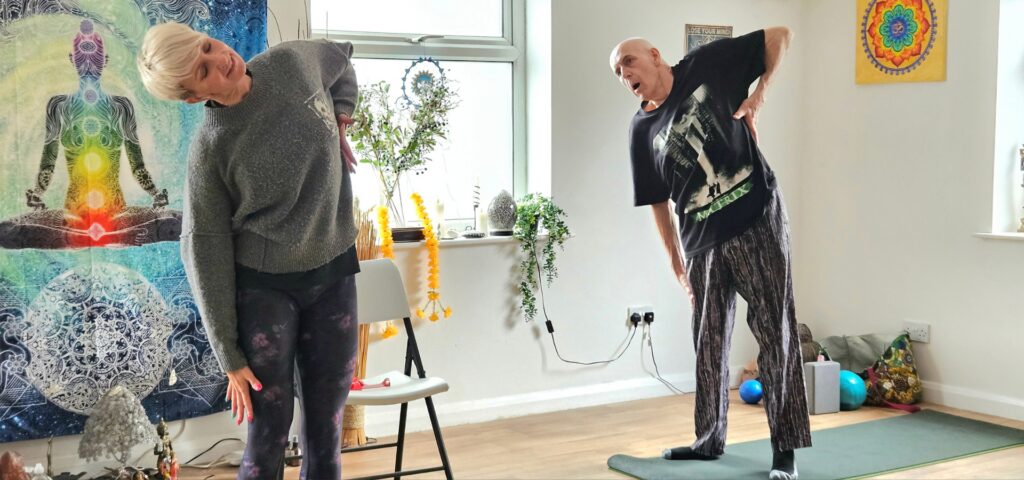
Photo credit: Michelle Griffiths, featuring a tutor and student at Mind Body Spirit studio in Barnsley.
For all media enquiries
Natalie Lyndon, BWY PR & Communications Officer